I am excited to have this second episode in the four-part mini-series where I’m sharing with you the Elite Business Growth Method. If you read the last episode, you’ll recall that we talked about some of the common pains, frustrations, concerns, and stressors that you experience as a business owner that only other business owners can truly relate to. I hope that wasn’t too painful. I just wanted you to know I know what it’s like. I’ve worked with many people like you who felt those same frustrations. Why did we go through that? There’s an answer. There are things that we can do to overcome all of those pains, frustrations, concerns, and stressors.
We also reviewed the stages of small business growth and how the journey from $300,000 in revenue to $1 million in revenue is all about creating a steady operation with predictable customer acquisition, and consistent fulfillment. Once you’ve arrived at that $1 million in revenue, you’ve really only begun the next leg of the business growth journey. Sometimes it feels like, “I arrived. We got there,” but we find out that we’re just starting a new leg of the journey.
We talked about how the people, processes, and systems that helped you get to $1 million in revenue that will likely be insufficient to enable you to get to $3 million will not take you to $10 million. Whether or not you plan to grow, you don’t want to be stuck in a situation where the business is consuming you. You’ll need to upgrade some combination of your people, processes, and systems if you want to grow further than where you’re at now, and likely, if you want to just enjoy life more than you do now. Remember, what got you here or what got you to this place will not get you there to a better place.
You can try to fight this reality all that you want. I know lots of business owners who are stick-it-to-the-man types of people. They’ve got a little bit of a rebellious streak to them or, “I’ll show you.” You could try to fight this law of business all you want, but it will likely be like banging your head against a brick wall. You must have a $3 million people, processes, and systems in place if you want to maintain that level of business. The same is true at $10 million, at $30 million, at $100 million, and so on.
I personally experienced the transformations that we had to go through as a business to go to $10 million, then $30 million, then $100 million. You can’t buck the trends on this guys and gals. You either learn the rules of the higher-level game or you get stuck playing at the level that you’re at now. There’s no real shame in that. It’s just the truth.
By the way, there isn’t just staying where you’re at. If you don’t want to grow further, you don’t have to worry about upgrading your people, processes, and systems. However, eventually, the grow-or-die principle will catch up to you. I won’t get into the grow-or-die thing here. You can listen to many other people talk about that truth.
In the previous episode, I then went on to introduce the idea of a method that has helped hundreds of business owners like you successfully make the transition from a scrappy, superhuman, gritty, tenacious entrepreneur who wills the business forward to a capable business builder who knows how to put the right people, processes, and systems in place to enable a growing team of people to take targeted, coordinated action to achieve your goals. That’s the trick. You got to go from the person who’s holding altogether yourself and sometimes super involved still in the day-to-day to somebody who knows how to build the business. It’s different.
The Elite Business Growth Method
We call the method the Elite Business Growth Method. It’s proven. It’s a practical approach. It’s based on our own success in growing our seven-figure business. The method includes the mindsets, skillset, and toolset needed to grow your seven-figure business without going crazy, or at least without driving yourself into the ground. We don’t want those things for you. We want you to have a happy, healthy business and a happy, healthy life.
You’ll recall that the first step in this Elite Business Growth Method is to set the vision. I covered that in the last episode. If you didn’t catch it, you can go back to it. If you need a refresher on setting the vision, you just have to go to that first episode in the mini-series and read it again. For the rest of this episode and the next, episodes 2 and 3 in the mini-series, I’m going to talk about the two major components of every business, the longer-term strategic progress side of the business, which we’ll cover in this episode, and the shorter term operational excellence side of the business, which I’ll cover in episode three of the miniseries.
The Longer-Term Strategic Process Side
Michael Gerber, who many of you know, who’s the Creator of the E-Myth, emphatically taught that business owners should spend more time working on the business and less time working in the business. Working on the business side is the longer-term strategic progress side of things. It enables the future. Working in the business is what keeps the lights on. That’s the operational excellence side of the business. That’s what we’re all prone to doing. We grew up in the business doing that. The business grew up with us doing that. We have a hard time extracting ourselves and relinquishing control to a team, to individuals that can take ownership with accountability and run.
The trouble is, for most of us, we were there when it all happened. It wasn’t there until we created it. We were the ones to make it go. Creating systems and processes and bringing in people that can competently take those responsibilities from you isn’t easy to do when the daily operational demands of the business are screaming at you to pay attention to them every single day, all day long. We know this all too well.
Some people call it the whirlwind. Some people talk about putting out fires. Some people talk about getting stuck in the weeds. Whatever your favorite analogy or metaphor is, we get sucked into the day-to-day business. Some of us do it very willingly. It feels good. We know exactly what to do. We’re perfectly qualified to do it. We might be the most competent at it. We created it. We get a lot of good endorphins. We get a lot of good feeling by accomplishing so much, and so we allow ourselves to get sucked into these tasks that we’re good at and then we don’t work on the business.
How do we do it? How do we design into the ongoing running of our business adequate time to pay attention to the longer-term strategic progress side of the business, while ensuring the shorter-term operational excellence requirements so the business doesn’t suffer? Unfortunately, that’s a little bit of a teaser. You’ll have to wait until episode four to get to the answer for how.
In this episode, I want to teach you what the primary outcomes of working on the business should look like. There’s a structure on the strategic progress, the longer-term side of the business that I want to talk to you about. I’m going to teach you what that looks like, then we’ll get into how we do that balancing act between the longer term and the shorter term when we get to episode four.
We can’t start on the meat of this episode without going back and referencing one more thing from episode one. That is the vision setting work that I talked about in episode one. Specifically, I want to tie back to your mission. You’re never going to do anything in the business that veers you away from that guiding star of your purpose, that core why, that cause, that meaning, that reason that your business has life. That’s the guiding star.
We never want to get away from that. That’s a given. How do you make sure all of the people, the time, the money that gets invested in your business, and the management attention, etc., how do we make sure all of that gets aligned to achieve the current mission that you’re up to now? That’s what I want to talk about getting started here with the longer-term strategic progress side of your business.
A Well-Crafted Mission
A well-crafted mission is going to have accompanying mission goals. For example, if our mission at Elite Entrepreneurs is to help 1,000 Elite Entrepreneurs build meaningful businesses by the end of 2021, I want to give more shape to what winning looks like when we achieve that mission. Let me explain that. Mission goals for us might be things like the number of customers we have in each program. It might include a total revenue number at the end of 2021.

Business Growth: A well-crafted mission is going to have accompanying mission goals.
Maybe our mission goals include a customer value measure of some sort or a number of five-star Google reviews. Profit margin is another common mission goal. We don’t want to just help 1,000 Elite Entrepreneurs build meaningful businesses if that means having 1,000 customers on our lowest membership with very little margin and increased debt to finance the business. We don’t want to go bankrupt in order to achieve our mission.
Do you see the point here with mission goals? You need to identify whatever helps your team know how to keep score so that when the mission is accomplished, you can all look around at each other and know with confidence that you won. That’s what clearly defined mission goals do for you. It’s not sufficient to have the label or the headline of the mission goal, the clear what-by-when. That’s necessary but insufficient. You got to have that headline, “Here’s what we’re up to now.”
Mission Strategies
That’s the unifying rallying cry for the business, but then it must be supported by mission goals that help you keep score and help define what winning looks like when you achieve that mission. Once you have a clear destination of a well-articulated mission and accompanying mission goals, now you can create an effective strategy, which is the next part of the strategic progress or longer-term view of your business, to have a great strategy.
Don’t run away because I use the term strategy. I know that that term gets overused. It can get confusing. It means lots of things to lots of people. I’ve seen lots of companies with no strategy at all, or a vague mission that renders any strategy work ineffective. I’m going to keep this as simple as possible. Strategy means a lot of things to a lot of people. When we teach strategy, we invite people to think of strategy in terms of current strengths to leverage and future strengths to develop. Let me talk about what I mean by that.
You can start doing strategy work by simply asking yourself this question, “What strengths do we have now in the business that we believe we must continue to leverage if we want to increase our chances of achieving the current mission in the timeframe we chose?” Let me say that more simply, “What do we think we must continue to leverage if we want to increase the chances of us achieving the mission in the timeframe we chose?” That’s the question. You’re taking inventory of your current strengths, the things that did get you here.
I said what got you here won’t get you there. That’s true, but some of what got you here will continue to play a huge role in getting you where you want to go. We want to identify those things. Once you’ve identified some of the candidates for strengths to leverage, then you can ask yourselves, “What new strengths do we believe we must develop if we want to increase our chances of achieving the current mission in the timeframe we’ve chosen?” Once you’ve identified current strengths that you must leverage if you want to win, now we’re going to identify new strengths that we must develop if we want to win.
Now, the more challenging part of the whole thing. You identify all the strengths you might need to develop to achieve the mission, and then you narrow that down to 3 to 5. Here’s the challenging part. Take the narrowed-down list of strengths to leverage and the narrowed-down list of strengths to develop. You then have to combine them into one list of no more than 3 to 5 strengths to leverage and/or strengths to develop.
These select few strengths will become your mission strategies. All of the collective focus of your business, the focus, the attention, the investment, the decision-making, and anything that you would put towards achieving your mission is going to be poured into leveraging and/or developing these strengths that you’ve identified. You are going to route life-giving resources and life-giving blood to these key strengths, strengths to leverage, or strengths to develop. They’re the things that you think give you the best chance of winning, which means achieving your mission.
Now, a word of caution on this. If you set strategy in a vacuum, in other words, if you don’t do any scan of the external environment, if you don’t know what is happening in the market or the competitive landscape, if you don’t get a good read on the trends in technology, government regulations, consumer preferences, or whatever else might affect your ability to compete and win, you are running a great risk of choosing mission strategies that won’t allow you to achieve your mission.
What am I saying? Don’t fail to recognize what is happening outside of your business that could affect your chances of winning. Don’t ignore important warning signs or signals that the market might be trying to tell you. You’ll come up with 3 to 5 strengths to leverage and 3 to 5 strengths to develop and then you must narrow down. We cannot sufficiently give life-supporting resources, time, energy, management attention, etc., to all of those things. You must select a few critical things that are going to enable you to win. You have to combine that list down to 3 to 5 max strengths to leverage and/or strengths to develop to achieve your mission.
I said a lot there. Mission and mission goals, and because those are so clearly defined, now you can come up with a winning combination of mission strategies to go achieve those things. You cannot possibly invest in everything that comes your way. You cannot possibly build every possible strength. You must be choiceful. You must choose.
There’s a great speaker, author, and expert named Greg McKeown. He has a book called Essentialism. I strongly recommend it. You can’t be all things to all people. You can only do one thing really well. That’s his argument, be essential. Right in line with that argument, I’m saying, “Over the course of the life of your mission, which could be 3, 4, or 5 years out, what are the 3 to 5 levers you’re going to pull or develop in order to give you the best chance of achieving that mission?” Once you have clear mission strategies identified, and you’ve named them so that you don’t lose them, you need to preserve the essence of that strategy for the life of your mission.
Annual Priorities
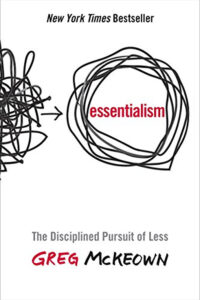
Essentialism: The Disciplined Pursuit of Less
The next step is to create annual priorities. The mission strategies are they’re alive and well for the entire life of the mission. Every year, if you do annual planning, which we’ll talk about in the fourth episode, you’ll want to take a look at those strategies and say, “Are those still the right strategies?” Maybe some things in the market have shifted. Maybe we have some new information. Maybe there are new technology advancements. There are lots of things that could cause you to adjust your strategy.
When you set them, the intent is that we think this is the winning formula for us to achieve the mission. That’s what strategy is. Unless in an annual review or a world-changing event like a Coronavirus pandemic, you aren’t likely going to change strategy that often. In the case of a disruptive event like a pandemic, we’re going to look at strategy and make sure we still have the right strategy.
When you’re doing your rhythmic annual planning that we’ll talk about in the fourth episode of this miniseries, we’re going to take a look at our strategy and make sure they’re still the right things. Normally, business as usual, in the running of your business over the life of your mission, you’re going to have these strategies to be your guide for where you should spend time, money, and energy, and what things you should be working on.
The next step in this process is annual priorities. You can’t effectively invest in every single one of your strategies every single year. In other words, if you chose five strategies, you said to me, “Brett, these five strategies must be in place in order for us to win. We are not going to achieve our mission without these five strategies,” I can concede to that. Over a 3, 4, or 5-year period, there’s plenty of time and there will be more runway and resources that you can direct toward these strategies.
However, in year one of that mission, you might not be able to invest in all five strategies. In fact, I would strongly encourage you to narrow it down to just three annual priorities. It’s hard for most businesses to pay real attention and to give adequate focus to more than three things in a year. Some of you might even acknowledge to yourself, “The number one priority I have is going to take every single ounce of focus that we have this year. All of our available resources, all of our excess bandwidth, anything that we have left over to pour into strategic progress, we’re going to pour it into this one annual priority,” and they just choose one. Try not to do more than three. You will find that you can’t give enough attention to things if you choose more than three annual priorities.
These annual priorities should have a named owner on the team. Usually, that means one of the leaders. It doesn’t have to be you as the business owner every time. It could be one of your right-hand person. If you have a management team and a formal leadership team, could be one of the other leaders in the business. There should be an identified owner, somebody to carry this banner throughout the entire year and make sure that we’re making sufficient progress toward that annual priority.
You need clearly defined measurable evidence of success. Sometimes we call it, “We win if,” or evidence of success. Whatever you like to call it, there needs to be a label for your annual priority that everyone can remember. There needs to be an owner who’s going to champion that cause the entire year long. There needs to be clearly defined and measurable evidence of success or success criteria.
With that level of specificity in place for the annual priorities, you don’t take it any further at this point. You don’t have projects identified yet. I’ll get to that soon. These annual priorities should be broad enough in impact and scope to merit a full year’s worth of attention. In other words, don’t put on there, “Launch our new product,” if you guys are going to launch it in the first quarter. That’s not an annual priority. That would be something that you’d get done in one quarter.
Don’t put on there, “Revamp our website,” if that’s going to happen next month. That’s not an annual priority. Pick something that everybody on the team would understand that this needs our sufficient attention throughout the year to make sure that we move it forward. Everybody will know about it. Everyone will support it in whatever’s appropriate for their role on the team. It should be a year’s worth of focus. It should merit a year’s worth of attention. That’s what a good annual priority would do.
Once you have those annual priorities in place, no more than three, and if 1 or 2 is better for your situation then just do 1 or 2, now we should be aligning our people, our spending, and anything that needs to be aligned to that would need to be allocated to make sure that it’s going to happen. You’re giving a signal to the entire team that, “This year, we are going to move this forward.” What does that look like? How do we get moving on that?
Quarterly Priorities
Once you have annual priorities in place, now we are going to talk about quarterly priorities. Same thing as the annual priorities, a little bit different, but you are going to have no more than three. I strongly recommend focusing on these quarterly priorities. You’re going to have a label for them. It may or may not be the same exact label as the annual priority.
If an annual priority is to crank up our lead gen machine, maybe the Q1 priority is around mastering Google AdWords, like, “We’re going to get our Google AdWords game. Game on with Google AdWords.” Maybe that’s the title of your quarterly priority. Now, you still need an owner for the quarterly priority. It might be the same owner as the annual priority, but it could be a team member. It could be another one of the leaders on the leadership team. Whoever it is that should be the point person for the quarterly priority for the entire quarter, that’s who you’re going to name as the owner of that. Just like with the annual priorities, we want to have evidence of success for the quarterly priorities.
Here’s where it’s different. We don’t stop there. We don’t just stop with a nice quarterly priority label, a clearly defined owner, and evidence of success. Now, we get into the work plan. What are we going to do this quarter to achieve our quarterly priorities in line with the annual priorities? When we’re done with this quarter, then we’re going to set up the quarterly priorities for the next quarter. We’re going to identify that body of work for that quarter and we’re going to knock it out, then we’ll set up the next one. I don’t want a whole year’s worth of quarterly priorities and a whole year’s worth of action plans. I want annual priorities. I want this next quarter’s priorities, and then a very well-planned action plan for how we’re going to get that done. We call those SMARTs.
Let me explain what SMARTs are. SMARTs are the specific tasks or the work that has to be done in order to achieve our quarterly priorities as measured by the evidence of success that we articulated for each of the priorities. If I have a priority this quarter of Game on with Google AdWords, then I have an owner, Let’s say Sally Smith is the owner of that quarterly priority. The evidence of success would be something like, “We are investing in Google AdWords. Maybe we weren’t doing that at the beginning of the quarter, and by the end of the quarter, we have this much spend going to Google AdWords.” That would probably be horrible evidence of success if that were the only measurement, which is spend. Anybody can spend.
Now, maybe an accompanying evidence of success would be the number of leads generated by that AdWord spend, or maybe it’s the number of visitors to our website or the number of people coming to our website that translates into this many new opportunities for us. Maybe there’s a conversion measurement as well. Whatever the evidence of success are for that priority needs to be outlined, but then the SMARTs would be the work underneath it to actually get it done.
SMART Goals
Let me explain SMARTs. Most of you have probably heard the acronym SMART or SMART objectives or SMART goals. There are lots of interpretations of what SMARTs stand for. I’m going to give you our interpretation of SMARTs or the acronym that we use. I’ll encourage you to adopt it because I do think it’s the best one or I wouldn’t use it. If you have your own method, fine, but let me introduce it to you the way that we see it and tell you why. Maybe I can convert you over to my definition of SMARTs.
S stands for Specific. That’s usually most people’s definition of S. M in SMARTs is Measurable. A is Achievable, or some people say Attainable. That’s fine. R is where the differences usually come in. A lot of people say R should be Realistic. We already have A that said achievable or attainable. Why do we need an R that stands for Realistic? For us, the R stands for Relevant. Where’s the relevance? The relevance is that the SMART should support the quarterly priorities, which are in support of the annual priorities. Those annual priorities are in line with our strategy, and the strategy supports the mission and the mission goals.

Business Growth: Our definition of SMART: specific, measurable, achievable, relevant, and time-bound.
We have a mission, mission goals, mission strategies, annual priorities, quarterly priorities, and now SMARTs. If this work isn’t relevant to the whole plan here, the game plan, then we shouldn’t be doing it. That’s why we go with relevant for R. T is Time-bound. In other words, there needs to be a due date. In our former example of a priority that says Game on with Google AdWords, in our annual priority that says crank up the lead gen machine, then there might be a SMART that says, “We need somebody to create a Google AdWords account, or go learn Google AdWords, or maybe we hire a partner that we’re going to work with for Google AdWords.” Whatever the project or tasks are that must be completed in order to achieve the quarterly priority, then we’re going to create SMARTs around it. It needs to be specific and measurable.
Clate, who many of you know I used to work with, would say, “We don’t need a SMAT. We don’t need an ART. We don’t need a MAT. We need SMARTs.” They have to meet all of the criteria for being a good SMART, Specific, Measurable, Achievable, Relevant, and Time-bound. Maybe the specific thing is to set up our Google AdWords account complete with the payment thing that’s going to happen every month. Somebody owns it. It’s measurable. It’s done. It is achievable in the time that we’ve picked. It’s relevant to the quarterly priority. Let’s put a due date of July 31st. We have that done. Make sure there’s an owner to it, that you’ve got a description for the deliverable, it’s measurable, that it’s relevant, and that you’ve got a good due date on it. That’s a good structure for a SMART.
Let’s step back. I’ve given you the cascading from the big picture on the strategic side of your business, the mission and mission goals, to strategies, to annual priorities, to quarterly priorities, to SMARTs, the actual work we’re going to do this quarter to move the longer-term strategic progress side of the business forward. Most of us are getting stuck in the day-to-day operational excellence side of the business, the shorter-term view, because of all the reasons we talked about on the front end of this call. We’ll get to some great practices to help you on that side of the business in episode three.
Don’t Get Stuck In The Rat Race
I hope that I didn’t just blow your brain with too much detail. I know I got a little excited. What I want you to know is that it is possible. Through this Elite Business Growth Method, you can keep an eye on the strategic progress side of the business. There is a structure. There are processes. There are templates and tools to help you keep moving the business forward with the long-term view, the strategic progress side of the business. You don’t have to just get stuck working in the business. There are very defined ways to work on the business that any business owner can learn. We have that in the Elite Business Growth Method.
Whether or not you use our Growth Method, you must find time, ways, or processes for your business to keep the strategic progress side of the business moving forward or you’ll end up in the never-ending rat race of just doing it. As Michael Gerber says, “Doing it, doing it, doing it.” You got to stop doing it and start working on the business so that you can change the nature of what you’re doing. You want to keep growing. You want to keep evolving. You want to keep developing strengths in your business and new capabilities that allow you to move forward. The only way to do that is by using a structure like the Elite Business Growth Method and the structure that I laid out for you in this episode of mission, mission goals, mission strategies, annual priorities, quarterly priorities, and SMARTs. I hope you found that helpful.
In episode three, we’re going to hit the short-term focus, the operational excellence side of the business. You have a lot of experience over there in terms of getting the work done, keeping the lights on, making sure you can hit payroll and all the other things that you do to juggle those balls. I’m going to give you some ideas about how to organize work, and how to hire, lead, and fire to the vision in a way that enables you to get a better handle on the short-term operational excellence work that you must do to keep the lights on.
As I mentioned earlier, in episode four, we’re going to give you the meeting rhythm, the way to bring the short-term and the long-term together. How do we keep our eyes on both of those things and move them forward so that the entire team can take targeted, coordinated action to achieve our goals in the short term and the long term?
I hope that was helpful. Again, you can go to our website, GrowWithElite.com. You can send us an email at info@GrowWithElite.com. We are happy to help you with this Elite Business Growth Method. Next episode, we got episode three of this mini-series. You’re not going to want to miss it. Share it with others. You guys all have business owner friends who are dealing with similar challenges. Please don’t be selfish. Share what you’re learning. Share this episode. We love you guys. Keep reading.
Important Links
- Episode 1 – The Elite Business Growth Method: Episode One, with Brett Gilliland
- E-Myth
- Essentialism
- info@GrowWithElite.com