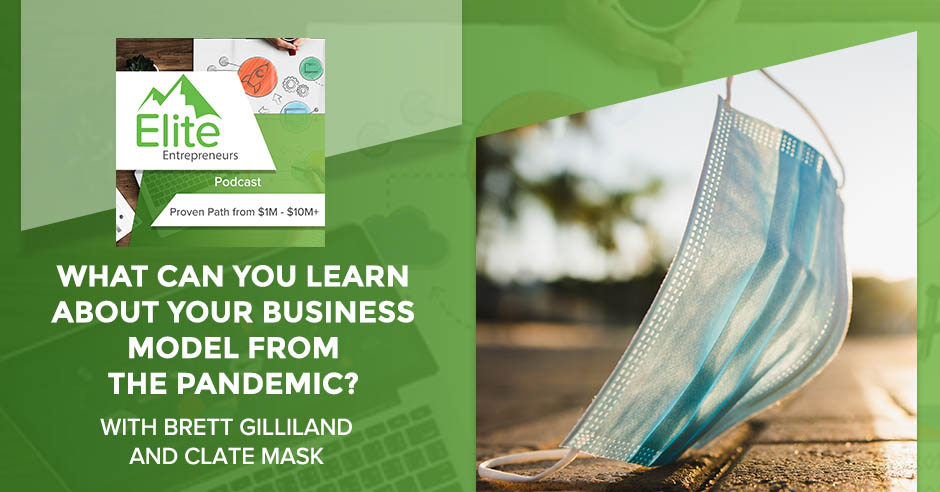
I’m doing something a little different this week. I’m going to switch over here momentarily to a recorded conversation that I had with a business owner. You’ll be familiar with his name if you’ve read any of my episodes in the past. His name is Clate Mask. We’re about to switch over, but for the past couple of months, as we’ve been in this COVID-19 crisis, we’ve put out several resources for business owners.
One of those resources was this interview that I’m sharing with you on this episode. If you’re interested in any of the other resources we’ve put out, they’re all dedicated or aimed at helping you with managing cash and leading people during these unusual times. There are several free resources on there. The website is GrowWithElite.com/COVID.
Anything related to managing cash or leading people that you might still need help with as you’re coming out of this COVID-19 pandemic, there are a bunch of free resources there, including the total call that I’m about to share an excerpt from for this show. I hope you enjoy reading what Clate and I talked about lessons that we’ve learned during this pandemic and how you can think about ways to improve your business as a result of this adversity that we’re all facing. Enjoy the episode and then make sure you read my closing remarks at the tail end of it.
Clate Mask is one of the Cofounders and CEO of Keap. He is a co-author, along with Scott Martino, one of the other cofounders of Keap, of a book called Conquer the Chaos: How to Grow a Successful Small Business Without Going Crazy. If my memory serves me correctly, that was sometime in the 2008-2009 timeframe.
I don’t know what Clate thinks of this, but I call him an honorary Cofounder of Elite Entrepreneurs. Many of you know that this business, Elite Entrepreneurs, the one I run now, was born inside of Infusionsoft, which is now Keap. It wouldn’t exist if it weren’t for Clate. Many of the practical lessons and examples that we share in Elite Entrepreneurs come from Clate directly and the work that I was privileged to do with him there. When I bought that business and we spun it out of Infusionsoft at the time, a couple of years ago, I told him he just is always going to be the honorary cofounder of this business. Welcome, Clate.
Thank you.
I’m honored and thankful that I have the opportunity to do this because of a lot of things that you did to make that possible. I want to tell people, Clate, the story to set this up, how I had a phone call with you and we were talking about my role as the Owner and Leader of Elite Entrepreneurs. From time to time, your guidance or thought partnering, or the questions that you ask are valuable to me in this business.
You asked me the question, “What is COVID or what has COVID been trying to teach you about your business model?” That question was one of those lightning-bolt moments or hit-you-like-a-ton-of-bricks moments where I hadn’t paused to reflect on that specific question. The insights that followed for me and my business were super invaluable. They were off-the-charts invaluable.
When I got off the phone with you and I was thinking about what I could share with the community of business owners we’ve been trying to serve over the last several weeks, I thought of that question and how impactful it was. I thought, “We need to do that for other people.” Thank you for making a little more time to make this available to more people.
I have a huge amount of respect for this person, but I got an email from somebody who thought that the subject line, “What is COVID trying to teach you about your business?” was insensitive to the fact that people are suffering right now and their businesses are suffering and that I was just trying to get clicks. I tried to assure him in an email back, “That wasn’t it.”
I had one of the most meaningful experiences as a business owner in a brief coaching interaction with you where you asked me this question. It opened my mind in a way that, frankly, hadn’t happened for some time. I was thankful for that moment. That’s all I’m trying to share here, so tons of acknowledgment.
With all due respect to all of us, my business isn’t suffering as much as many others that have been forced to shut down during this time. I know there’s a lot of pain and suffering around the pandemic. In no way, shape, or form, am I trying to make light of that or get clicks by using that subject line. It was just so meaningful for me as a person, as a business owner, to hear that question come from Clate. It caused me to reflect in ways that I hadn’t. It was very useful.
That’s the spirit with which we bring this topic and the question. I teed it up a little bit, Clate, but I would love for you to share for everyone on the call any context for how that question came to be meaningful for you and why it is that you were able to share that with me. Where did that come from? What has that thinking done for you?
I’m glad you shared with me the part about people who look at this not just as a provocative question, but as an inflammatory and insensitive question. It’s not intended that way at all. It comes from the place of us as entrepreneurs always trying to learn and get better. It comes from the place of leaders never failing to use a crisis to create the change and the progress that’s needed.
It’s hard when we’re in the middle of that crisis. It can appear calloused or insensitive when a leader is saying, “We need to move forward. We need to push through this.” I understand because many times, people aren’t in that place. Like all of us, when this hit, I felt fear. I felt concerned. I felt worried. My heart went out to our customers, our employees, our partners, and everybody associated with the business that we serve and that we work with.
I knew right away this was going to have a major impact, yet I also know, from being an entrepreneur, that when we’re in a place of fear, we can’t accomplish what we need to accomplish. We can’t create what we need to create because fear and creation don’t work together. You have to be out of fear in order to create.
I quickly pulled myself through that process and, occasionally, will fall back into that fear. I’m not immune from fear. I have a reminder on my wall, “No ego, no fear.” You know that I see that every day. I have it at the bottom of the email. I think about this all the time, but when we’re in a place of fear, there are good reasons to be afraid. It’s not like I’m saying, “You shouldn’t be afraid. There’s no reason to be afraid.” There are good reasons to be afraid.
To answer your question, the place that that question comes from, “What is COVID trying to teach you as a business owner? What is it trying to teach you about your business?” is that every crisis creates opportunity. Every big challenge can push us out of a rigid mindset that we sometimes get stuck in. When challenges and problems arise like this, it’s the entrepreneurs that are thinking in a creative way, pulling economies out of the recessions that follow issues like this.
I’m trying to rally entrepreneurs to say, “How can you think differently about your business for you, for your employees, for your customers, and for all of the people that you’re trying to make an impact on in the world?” As you do that, and you do a great job of that, you have the ability to start to lift the tide for everybody. As you start to have success and you spend, then the businesses that you spend with start to have success and they spend, and the ripple effects of a healthy economy continue.
I’m an Economics major. That’s what I studied at Arizona State. When I see an event like this, the leader, the economist, and the entrepreneur in me all come together and say, “How can we create something positive out of something that is so tragic and that we can be mired in?” It doesn’t do us any good to be stuck in that place.
I’m doing several calls a day working with entrepreneurs to get us to think differently. Before we can even pose the question or address the question that is the subject of this webinar, we have to first recognize that we got to get our hands into a positive place. I’ve done lots of conversations and lots of webinars and lots of calls about conquering the COVID chaos because if we don’t get our minds in the right place, then we can’t begin to create and solve problems and look at how we can learn from this crisis. Hopefully, that’s helpful.
It’s super helpful. Let me jump in here real quick and just ask because you referenced this. I wasn’t planning on this but it’s helpful. You said something like, “I had to pull myself through that process first.” From going from a place where naturally we can all respond with some fear or uncertainty, how did you pull yourself through that process to a place of more creative, “I’m going to learn what we need to learn out of this?” If you could share just some practical ideas about how you pull yourself through that, everybody on this call needs to do some version of that from time to time.
You bet. Before I do that, let me just say I’m not immune to any of those pressures and concerns that entrepreneurs are having. You might think I’ve raised a bunch of venture capital. That money’s spent. We don’t have just piles of money behind us. That’s not the reality. When canceling starts to go through the roof, lead generation dries up, employees are saying, “I don’t know if I can work from home,” equipment realities, and all of the physical realities of trying to mobilize 400 people to work from home, those are real challenges.
I had real oh-crap moments of, “What are we going to do?” If you’re close to our business, we went through a couple of challenging years that we were just starting to come out of when this thing hit on March 11th, 2020. I want to be candid in saying I felt those pressures and those concerns and those existential threats. I felt those very real board members calling me saying, “What are we going to do?” I want to make it real for a second. I felt those fears. I recognized that that wasn’t going to do us any good to be in that place of fear, so we mobilized quickly.
We came up with plans of how we would get our people, our keepers, and our employees to where they could be productive. We worked hard and aggressively to get that done. It took us about a week, but we got that done. In the meantime, we allowed people to work from home as they wanted to and could. Within a week, we had everybody work from home. That was no small feat.
One thing that COVID taught me was we needed to be more adaptive, and nimbler in our response, although our team did an amazing job. I have given them huge praise as a leader and as a leadership team. We weren’t quite ready, at the drop of a hat, all work remote remotely. That was interesting. I had that fear.

Business Model: One thing that COVID taught us is that we need to be more adaptive and nimble in our responses.
To answer your question, how did I pull through that? I practice the things that I teach and conquer the chaos, emotional capital, disciplined optimism, and entrepreneurial independence, those three things. Scott and I have created another one that we began teaching our customers about, that we’ve been practicing over the years. That’s not in the book but it will be in the revised edition that we call mind over meaning.
Our minds are meaning-making machines. Stuff happens and we make it mean something. We put the meaning to it and our minds can go to a very dark place of created meaning. You have to stop that. You have to say, “Hold on. Is that what’s going on? Can I be sure of that? Can I make an adjustment? Can I look at this in a different way?”
Getting control of my mind was critical, as getting control of my emotions and feeding emotional capital practical, simple things. I stopped looking at the stats, reading the news, and listening to stuff all the time. Instead, I worked hard all through the day. I would check in at night to see what the update was, and then right back the next day to working hard and driving on our outcomes. I stopped inundating myself with the negativity. I consciously and intentionally chose to focus on positives everywhere I could find them. I put that into practice in our company.
We’ve had a positive focus practice in the business for a long time that was loose and it wasn’t very strict. We got back to very strictly, “What are you positive about personally? What are you positive about in the business?” Let’s surface every positive thing that we can see in the business. That was another part of what we did.
What I did was practice what we teach in Conquer the Chaos. I practice disciplined optimism, emotional capital, and entrepreneurial independence and the fourth one that Scott and I have been teaching is mind over meaning. Once you do that, you can get into a place where you start to see some good things. You start to recognize opportunities. Your mind gets into a place where it can begin to create instead of being in a place of fear where everything feels like it’s contracting and caving in on you.
I appreciate you taking us through some of that. Let’s transition now to the question you asked me, which was, “What is COVID, this pandemic, or this crisis environment trying to teach you about your business model?” That was such a great question for me to wrestle with for even a few minutes with your help. This is unscripted. I don’t know if we want to go to what you learned about your business as examples, or what I learned about my business. We want to first start with some thoughts behind the question itself, whatever you think would be useful.
This jarring event is ongoing. It’s a crisis. It’s not just an event. When we have these things, they create industries. It changes lifestyle. Think about what happened with 9/11 and our experience in the airport, how different it is versus what it was back then. Entire businesses and even industries get created out of things like this.
You might say, “We’ve never had anything like this.” We’ve had pretty major things happen in the world. Whether it’s World Wars, 9/11, or the flu of 1918, there are major changes that happen and sometimes, we get a little bit immune to how our lives can change so dramatically. Frankly, we’ve had a couple of decades of pretty nice times. We’ve forgotten how our world can get rattled like this. Whether it’s an act of God in a certain region, a pandemic like this, or a World War, it rocks everything. It’s the entrepreneurs’ job to assess what’s going on and figure out how do we adapt.
That’s why I talk about this because it’s a huge opportunity. I don’t say that in a profiteering way. I don’t say that in a way of trying to be insensitive to the pain, and not only the health impact but the economic impact of 22 million Americans that are out of work that wasn’t a few weeks ago. I’m not trying to be insensitive to that at all when I say, “Let’s recognize the opportunity.” What I’m saying is opportunity is just challenges and problems dressed in a different way. It’s truly the entrepreneur’s job to see the challenge and look at it differently.
I’m glad that person sent you that email. It illustrates what we have to do as entrepreneurs. If that entrepreneur can get him or herself out of that fearful place they’re in, he or she will start to see the opportunities. They’ll start to learn what they need to do in their business, and what problems are being brought to them by customers that they could now start to solve that they didn’t solve before. What products are out there that they need to be adopting and bringing to their customers? There are all kinds of things. We have to begin to break down the problem that looks like a menace and turn it into an opportunity.
I don’t know if you’ve even given this any thought, but one of my favorite parts about the question you asked me, “What is COVID trying to teach me?” is that idea that I might not be listening. I might not be paying attention to the lessons that I could be learning. That question unlocked that for me. “What is it trying to teach me? There are messages coming my way. Am I paying attention?”
The trying is two levels. You have resistance to it on two levels. The first is what we’ve been talking about here primarily, which is just the fear, the concern, the way our heart goes out to all those who are affected, that blocks our learning. The other thing that blocks our learning is the rut or the mode that we may have been in for 3 years, 5 years, or 10 years leading up to this. Economists call recessions economic corrections. Economists are a little weird this way. I have just enough in me as an Economics major, but I can associate myself with the good parts and disassociate myself from the bad parts.
We’re going to call you a little weird.
Here’s the fact, economists make a bunch of assumptions about how economies work. When things get out of whack, there’s a correction that’s required. The same thing happens in our businesses. We get into certain grooves and certain ruts and it goes a certain way. An event like this can correct us. Let me give you an example. For a long time, our customers came into our business through the sales team. In other words, they had a phone call with sales or they talked to a partner.
A few months ago, we started to work on enabling our customers to buy the software online. Our business was trying to get to that place and COVID accelerated for us the work we were doing to make it possible for our customers to buy our software online. There will always be a bunch that wants to talk to sales. There will always be a bunch that comes through partners, but we have begun to sell online. This month, we’ve got dramatically higher online sales than we’ve ever had before. We started doing it in November 2019. It’s been accelerated by COVID.
Business Model: COVID literally accelerated for us the work we were doing to make it possible for our customers to buy our software online.
That’s an example of, on the one hand, COVID is trying to teach you something, on the other hand, life has been trying to teach you something, the market has been trying to teach you something, and you may have been resistant to it. It’s all, “How can COVID teach us something that maybe we’ve been resistant to for business reasons or we’ve been resistant to over the last few weeks for fear and realities of what we’re all struggling with?”
That’s super interesting. I’ve talked to a lot of business owners as you have, not as many as you have, and some of them have recognized the thing that they were trying to do. We’ve been trying to increase our ability to sell to customers online without talking to somebody. This crisis that we all know as COVID-19 has created a different receptivity to the market around how goods and services are traded, or something like this. Instead of a live event, this is live but we can do it over a technology platform like Zoom.
In a lot of the ways that we used to operate, the rules have changed. Even if the rules haven’t changed, the reception of consumers or businesses that you serve has dramatically shifted and allows you to behave differently than you could even if you were already trying to move that way within the last few months.
That’s why a crisis can be such a great thing. That sounds so callous to say it, and I don’t mean that at all.
That’s the weird little economist part in you, the correction part.
It sounds awful to say that, but if you look back at industries and companies and solutions that were created out of crisis, it’s amazing. You look at what’s going to happen. If we fast forward five years, you will see major companies, businesses, and kinds of things that have solutions to problems that come out of this crisis.
When crises hit, you’ve got a choice. You can just bury yourself and wait for it to go by or you can stand up and lead. Leaders have got to lead. Sometimes we get criticized going through that process because it looks insensitive. It’s not insensitive. It’s out of an abundance of care that we’ve got to pull ourselves through this and get everybody through this as fast as we can. That happens when entrepreneurs start to take action on the opportunities that they’re seeing. Not in a profiteering evil capitalistic way, but in a problem-solving good capitalistic way where people want to pay for the good that you’re doing and the problems that you’re solving.
I’m a conscious capitalist. I believe that a business should bless the lives of its employees, customers, partners, and everybody associated with the business. For that to happen, you’ve got to see the problem and create the solution and start delivering it. What’s happening right now is problems are coming to us as entrepreneurs in ways we’ve never seen before. Sometimes they look scary, but it’s opportunities for us to go and create solutions.
I genuinely appreciated when you posed the question to me. I felt like I was already in a positive mindset. I felt like I was looking for solutions and being creative. I hadn’t wrestled with that question of what is it trying to teach me. What is this environment that we’re in, this pandemic, trying to teach me about the business model? I don’t know if it would be helpful for me to share some of the things that I took away from that for our business as examples or maybe even see if somebody’s willing to raise their hand and we work through.
Let’s share examples. You share examples. Audience members can share. I’ll share some things that I’ve watched our customers do, which are inspiring and awesome. I’ve shared one of the things, but there are a handful of things that we feel like COVID has been teaching us.
When Clate asked me the question, “What is COVID trying to teach you about your business model?” there were three things that came to mind pretty easily. They may or may not relate to you, but at least sharing what happened for me, might unlock some thinking for all of you. The first thing that I recognized is that this environment, this pandemic has been trying to teach me.
The Elite Entrepreneurs’ business model, or historically I should say, has been too reliant on the ability for people to travel and assemble in the same physical space. That’s not an uncommon lesson being taught to lots of businesses. That was first and foremost for me was, “Too much of the way that we’ve set up, how we deliver value to our customers, is reliant on being able to get in the same room together.”
Years ago, it was that way. You came and you spent 2 to 3 days together with us in a workshop and that has continued to be the staple of the program, that method of coming together, from the beginning.
Back to the rut thing that you said. This has always worked. This is how we’ve always done it. This environment is now inviting me and my team and to think differently about how to deliver value if the ways we’ve always done it, circumstances change. If that’s different, how can we deliver value in new ways? That’s one of the lessons that we’re taking away as a team and thinking about and working on.
The second thing that came to mind for me is that I feel like in our business, we’ve not been very good at putting together irresistible offers because of the time that we spent with Rick Barrera on one of these calls. Clate and others have tried to teach me over the years about putting together a good offer. I’ve learned some things about that, but I’ve not cracked the code on irresistible offers. I see super creative people all around me coming up with offers that I think, “I don’t have a lot of funds for that, but I want to get that. It looks so valuable.” There’s this irresistibility to it, which is why we call it an irresistible offer.
This environment is teaching me a lesson that I’ve been either resistant to learning or have just procrastinated. It hasn’t been top of mind. When we’re all trying to generate cash in an environment where it may feel less easy to do, how can we come at that in a new way? That’s been something that we’ve learned. The third one that I learned has to do with the way that I’m organized with my team. I’m learning that a flexible generalist or somebody who can wear lots of hats, play different roles, and contribute in different ways on the team, is more valuable than very narrowly specialized roles.
Some of those roles are less relevant right now and so you can’t get stuck in specialized roles if the environment is saying, “We got to go pivot and do this thing over here.” If you don’t have flexibility in your team and how you share the workload and redistribute work, you might find yourself in a problem, in a situation like we are. Those are three of the things that came to mind as Clate asked me that question. They were useful for me as a business owner.
Everybody can see this comment from Daniel. Daniel, thank you for sharing. He says, “I’ve been struck by how many things that I had assumed would always be done in person, even physical things like Pilates, exercise sessions, yoga sessions, somatic, etc. They’re now being done online with two-way video. It already seems so natural and effective. I can’t see going back to 100% in-person versions of all those things. There’s a new way now that our world is going to operate going forward because of the adjustments we’ve had to make.”
I commented to Daniel in there. One of the things we see across our customer base, we have a lot of coaches and speakers who rely on events, jumping on a plane, going, and speaking. We’ve got fitness companies who, to charge their monthly subscription, need their gym open. It was interesting. Right when the pandemic was declared and the travel restrictions implemented, our cancellation request went through the roof. We’re talking to customers and as we talked to them, a lot of times they would start to recognize things they could do exactly like Daniel’s talking about.
We’ve had so many customers who never could have imagined delivering their service virtually, who are doing it virtually. Karate dojos and dance studios, CrossFit gyms, consultants who generally are together with the customer, and people that are typically requiring that very tight interaction with their customers are now doing it online.
One of the stories I love is about a gym that was required to close its doors and was sure that they were going to go out of business. One of the owners of the gym said, “I’ve always wanted to create a nutrition program to offer to our members. I’ve dabbled in a little bit and done some things here and there.” She took the time to create the nutrition program and get it out to members.
It became a part of what built a greater community around her gym so that people would say, “Not only do I want to be able to go into the gym, but I also want to be a member so that I can get this nutrition program that you’ve created.” She sees that as being a way that she’s creating value now while they can’t come into the gym but it’ll become an added fee or an added service that she’ll get to charge for afterward.
When I say, “What does COVID teach you about your business model?” I’m implying that the world has been trying to get you to learn this for a while. The market has been wanting you to learn this for a while. COVID is making it real. That’s the, “Old necessity is the mother of all invention.” Now, you need to. It’s creating innovation. It’s creating an invention. That will create greater revenue streams, success, and profit in your business down the road.
Business Model: What does COVID teach you about your business model? It’s creating innovation that will create greater revenue streams, success, and profit in your business down the road.
—
That’s the end of my conversation with Clate for the purposes of this episode. I chose to cut it off there because you got the value that we were trying to share from that episode. For the purposes of this show, if you care to read the rest of it, it’s all on that resources page that I mentioned at the front end of the episode. That’s at GrowWithElite.com/COVID.
I hope you enjoyed hearing us share some of the things that the COVID-19 pandemic has taught us about our businesses. However, none of that matters if you don’t learn for yourself the lessons that the COVID-19 pandemic is trying to teach you about your business. If you’re serious about getting the real benefit from doing this exercise, I encourage you to find a thought partner. A thought partner will both help you explore the lessons being taught and perhaps more importantly, will increase the likelihood of you taking any necessary action.
If you don’t have a good go-to thought partner for something like this, our Elite Entrepreneurs team is happy to help out. All you have to do is send an email to Info@GrowWithElite.com. We’ll arrange a time to help you. One of our team members can be that thought partner for you. This wraps up this episode. I hope you found it useful.
We are here to serve all seven-figure businesses, those who will soon be crossing that million-dollar mark on your journey as far as you want to take it. Certainly, we know what it takes to go to $10 million and beyond if that is your objective, and we have a special Elite Business Growth Method that we’d love to share with people. Reach out if we can be of assistance to you on that.
I hope that you stay safe, that you’ve learned or are learning the lessons that COVID-19 is trying to teach you about your business, and that you come out of this pandemic even stronger as a business. Have a great week, everyone, and join us again in the next episode. We’re going to continue to bring you great business owner interviews, and occasionally, I’ll pause to share some thoughts of my own.
Important Links